The Crenshaw Battery at Gaines Mill
The Crenshaw Battery of the army of Northern Virginia, formed and supported by the family of Paul Crenshaw Briggs, was in action at the battle of Gaines Mill.
While both William G. Crenshaw and Edwin Barlow were on the same field and most likely would have tried to kill each other if possible, it doesn't appear that they were on the same part of the battlefield.
The modern map below shows the Crenshaw Battery almost in the center of the Confederate Line behind New Cold Harbor. In his official report, Captain William Crenshaw states the battery went into action in this location.
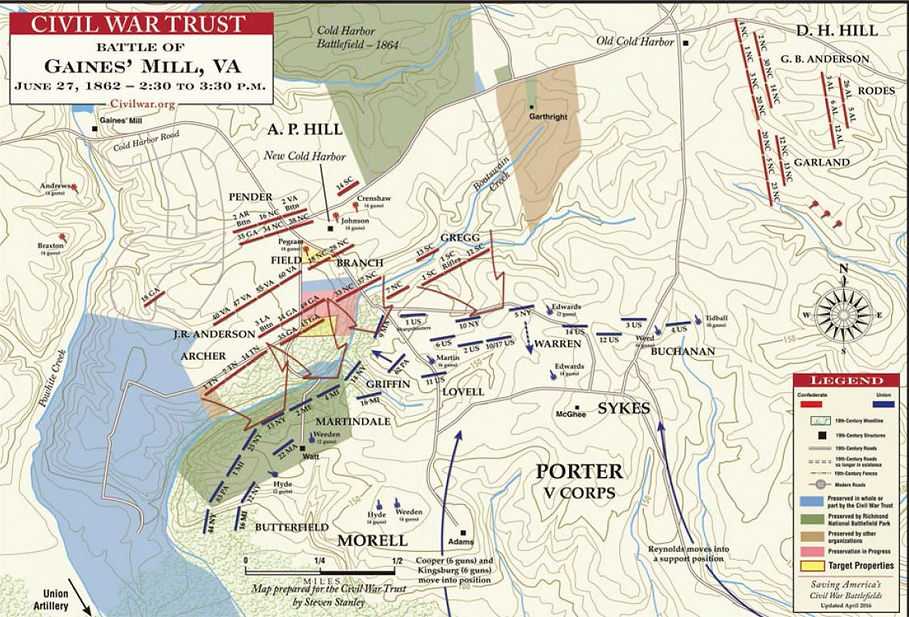
But the History of the Crenshaw Battery in the Papers of the Southern Historical Society state that the Battery went into action "in an open field just in rear of the Gaines house". On this map of the battlefield reported to have been made for have been for Gen. A.P. Hill after the battle, the Gaines House location, site of Gen. Lee's Headquarters makes it just possible that the 16th Michigan was under the fire the Crenshaw Battery.
I have included the after battle report of William Crenshaw and a short history of the Crenshaw Battery (Through Gaines Mill) from the Southern Historical Society.

REPORT OF CAPTAIN CRENSHAW.
Headquarters Crenshaw's Battery,
Near Richmond, July 14, 1862.
General: In obedience to your orders of the 10th instant, I beg leave respectfully to submit the following report:
Soon after receiving' your orders (while in camp at Dr. Friend's house, Wednesday, 25th June) to cook two days' rations, and prepare to march that evening, the enemy opened fire upon us from the earthworks he had just thrown up near Hogan's house, on the opposite side of the Chickahominy. This fire was kept up very constantly during the day, and resulted only in the killing of two of my horses. In accordance with your orders, the fire was not returned by me. Soon after, we started on the march, bivouacked near the brook, about three o’clock, at night, rested nearly all of Thursday in the road, and in the afternoon, crossed the Chickahominy at the Meadow Bridge, in the rear of your brigade. In accordance with your orders, I halted the battery under shelter of the hill, about half a mile this side of Mechanicsville, where we remained until next morning, receiving the shells of the enemy, but without taking any part in the fight. This shelling resulted in no loss to us.
On Friday morning, 27th June, we started down the Chickahominy in rear of your brigade, and my battery was the first to cross the bridge at Gaines' mill, which was effected about one o'clock, P. M. Soon after crossing, in accordance with your orders, we went into battery near New Cold Harbor house, and commenced firing at the enemy's infantry, who were drawn up in line of battle across the hill above us. They were soon scattered and driven out of our sight, and we were opened upon by three batteries of the enemy, on the same hill, who fired very rapidly, and against whom we then directed our fire. Unfortunately for us, our position was such that we could not maneuver our battery ten yards to the right or left, the opening in the woods through which we had to fire being very narrow. We continued under the incessant fire of the enemy's batteries for nearly two hours, ceasing our own fire more than once, when the charge on the enemy's batteries was ordered to be made by our infantry. During this engagement, I received your message to maneuver the battery or remove it from the field under fire, at my discretion. Finding that no infantry of the enemy were in sight, and that we had been so long under fire of their several batteries, that they had been able to get our range very accurately, and that we were being damaged by them, having lost in killed and seriously wounded five men and eleven horses, I, in the exercise of the discretion you gave me, withdrew my battery some two hundred yards from the field. After resting about three-quarters of an hour, and finding the enemy's infantry had formed on the hill above us again, we returned with the battery to its original position, soon scattering them, and then continued firing upon their batteries. While firing upon the infantry on the hill to my left, it was suggested that they might be friends, and we ceased firing upon them, a few moments until, with your assistance, we could examine them minutely with our glasses. You being satisfied that they were not friends, we, by your order, opened upon them again, when they soon disappeared from our view.
We continued in this second engagement about an hour, when two of our brass pieces becoming disabled by the breaking of the axles, and the other two brass pieces too hot to fire with safety, you ordered us to retire, to make room for Captain Johnson, who had been ordered up to relieve us. We had lost in it four men killed and seriously wounded, and eleven horses but succeeded in taking off the two disabled pieces by hand, and the others by dismounting our chiefs and hitching their horses to most of the pieces. In accordance with your orders, the battery was then taken to the rear, and Lieutenant Hobson started at twelve o’clock, that night to Richmond, with the disabled carriages for repairs, and a wagon for ammunition, and men to bring out more horses.
The next morning, Saturday 28th June, what ammunition we had left, consisting almost entirely of solid shot, canister and long-range rifle shell, was placed in the chests of three pieces, which we carried upon the battle field of the previous day. Soon after we arrived there, we received orders from Major General Hill to return with my battery to Richmond to refit, and remain for orders. Upon my informing you of these orders, you authorized me to rejoin you as soon as I had fited [sic] up, and that you would take the responsibility of my doing so without orders. I accordingly returned to Richmond, Saturday afternoon, remained there until the Thursday morning following, having succeeded in getting a temporary detail to my company of thirty men. With these I proceeded down the road and overtook your brigade just below the battle field of the Tuesday previous, remained with you until the return of the division to its present position near the city, without being in any other engagement. We fired between seven and eight hundred shots, with what loss to the enemy I do not know.
I thus sum up my loss. Nine men killed and seriously wounded, per list annexed, besides several others slightly wounded, and twenty- four horses killed and seriously wounded, including the two killed on the 25th of June. I went into the engagement with ninety four men and four officers. None of my men left their guns while they were in battery; only two who were in the first engagement failed to be present in the second; both of these sent me certificates of physicians that each had a foot so badly mashed as to unfit them for duty. Therefore, where all behaved so well, I cannot draw any distinction, and shall always be contented if, in the future, all do their duty as well as they did on the 27th of June, which was the first regular engagement the men were ever in.
Respectfully submitted by your obedient servant,
WM. G. CRENSHAW,
Captain Commanding Crenshaw’s
*****
The Crenshaw Battery - from the Southern Historical Society
On Friday, March 14, 1862, there assembled at the wholesale warehouse of Messrs. Crenshaw & Co., on the Basin bank, between Tenth and Eleventh streets, Richmond, Va., one of the jolliest, most rollicking, fun-loving crowd of youngsters, between the ages of 16 and 25, that were ever thrown together haphazard, composed of clerks, book-keepers, salesmen, compositors, with a small sprinkling of solid business men, from Richmond, reinforced with as sturdy-looking a lot of farmer boys from the counties of Orange, Louisa, Spotsylvania and Culpeper as one generally comes across.
The occasion of the gathering was the formation of an artillery company for active service in the field, and after the usual preliminaries, an organization was soon effected, with the following officers:
Captain, William G. Crenshaw.
Senior First Lieutenant, James Ellett.
Junior First Lieutenant, Charles L. Hobson.
Senior Second Lieutenant, Andrew B. Johnston.
Junior Second Lieutenant, Thorras Ellett.
The battery consisted of six guns: Two 10-pound Parrotts, two 12-pound brass Howitzers, and two 6-pound brass guns.
The company was christened ‘The Crenshaw Battery,’ in honor of its first captain. His gallant bearing on the field of battle subsequently, and his noble generosity to the company, always, proved that the name was fitly chosen. Captain Crenshaw equipped the battery with handsome uniforms, overcoats, blankets, shoes, underclothing, and everything necessary for its comfort, at his own expense, and advanced the money necessary for the purchase of horses and guns to the Confederate government, thereby getting into the field much earlier than would have been the case under ordinary circumstances.
The battery was sent first to Camp Lee for instruction, and in an incredibly short time had become so proficient in drill and field movements as to be ordered to the front. It saw its first service in the fields around Fredericksburg, being attached to a South Carolina brigade of infantry under Brigadier-General Maxey Gregg, where the bugles almost daily sounded an alarm, with the harnessing and and hitching of horses and a gallop down the Telegraph or Catharpin road, with cannoneers mounted; but no enemy to be found, was the usual result. The men became so accustomed to these alarms that they began to enjoy them, and they in no small degree preferred them to the long, tedious, and bloody campaign they were soon to enter upon.
In the mean time McClellan had landed his hosts on the Peninsula, Williamsburg had been fought, and his army was soon thundering at the gates of Richmond. Lee had concentrated his army in front of him, and the Crenshaw Battery was ordered to take position on the left of the line, and was soon to receive its baptism of fire in one of the most hotly-contested and hardest-fought battles of the war.
The Battery, with Gregg's Brigade, moved to about six miles north of Richmond, where the Light Division was formed under Major-General A. P. Hill, the Brigade and Battery being a part of it. Remained in this vicinity and at Friend's farm on the Chickahominy river, where the battery was engaged in several artillery duels with Federal batteries, one specially severe on the 20th of June, 1862, where several horses were killed and wounded, but fortunately no men were hurt.
On the 26th day of June, 1862, the Light Division, with this and other batteries, crossed the Chickahominy swamp and made an attack on the Federals at Mechanicsville, with the Purcell Battery in front, the Crenshaw Battery being immediately in the rear, where they were exposed to a very heavy fire, without the satisfaction of replying.
The Light Division continued the advance the next morning with the battery in the same position. In the mean time our forces in front had flanked the fortifications of the enemy, and forced them to evacuate and beat a hasty retreat. The Crenshaw Battery was hurried to the front to take part in the attack on Gaines' Mill; it went into battery in an open field just in rear of the Gaines house, where it fought for several hours a large force of artillery and infantry strongly entrenched, losing one sergeant and many men and horses, and having the guns (the axle of one broken) and caissons badly damaged, it held its position on the field until the ammunition was exhausted, when it was ordered to retire. As soon, however, as the ammunition chests could be refilled, the battery was again ordered back to the same position it had occupied, where it remained under a very hot artillery and infantry fire until nearly sundown, when ordered to retire, Marmaduke Johnson's battery taking its place.
The battery went into action with about eighty or ninety men, and came out after a six hours fight with one killed and eight wounded. Sergeant Sydney Strother was mortally wounded, and died the next day, and was buried by the battery on Sunday, June 29th, in Hollywood Cemetery. In this action three guns were disabled, about twenty-five horses killed and wounded, three caissons damaged, and harness very much injured.
The next morning the battery was ordered forward to join the division. Captain Crenshaw sent word that he could only bring three pieces. General Gregg's reply was: ‘Bring them along; they are as good as six of the enemy's.’ When the battery reached the brigade, Major-General A. P. Hill ordered it to go to Richmond and refit. Captain Crenshaw insisted, with the wish of General Gregg, that it should be allowed to go with the brigade, but General Hill said: ‘No! I have plenty of artillery, and you deserve to be sent to the rear, and go you shall.’
From http://www.perseus.tufts.edu/hopper/text?doc=Perseus%3Atext%3A2001.05.0289%3Achapter%3D1.44